Vous trouvez ici le catalogue des livres édités par le CETIM depuis sa fondation, en 1970.
Nos collections:
Collection PubliCetim. Des livres publiés par le CETIM ou collectifs dans un format poche. Souveraineté alimentaire, droit international, relations Nord/Sud, luttes pour l’émancipation des peuples et leur histoire, questions des migrations, environnement, modes de transformation de nos sociétés, sociétés transnationales…
Collection Pensées d’hier pour demain. Propose au public, jeune en particulier, de courts recueils de textes d’acteur.trices qui ont été au coeur de la lutte des peuples pour l’émancipation.
Collection Hors-série. Livres publiés en co-édition avec des organisations partenaires ou ne rentrant pas dans le format poche de la collection PubliCetim.
Des exemplaires imprimés des livres des 3 collections sont disponibles dans la mesure des stocks disponibles.
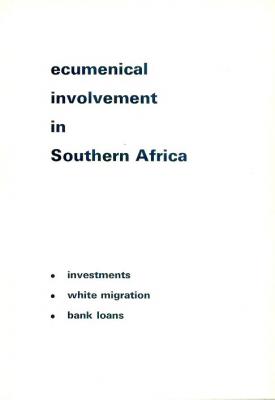
White migration to Southern Africa
Ouvrage collectif
1975 – pages
An european study compiled and produced by Angola Comité/Amsterdam, Anti-Apartheid Movement in Britain/London, Anti-Apartheid Movement in Ireland/Dublin, Boycot Outspan Aktie/Leiden, Centre Europe – Tiers Monde/Geneva, Comité contre le colonialisme et l’apartheid/Brussels, Ecumenical Research Exchange/Rotterdam, Informationsstelle Südliches Afrika/Bonn, International Defence and Aid Fund for Spouthern Afrika/London
Lire la suite
War on terrorism and respect for Human Rights
Melik Özden
2007 – 56 pages
Since the beginning of this new millennium, terms such as terrorist, terrorism, fight against terrorism, etc. are part of everyone’s daily life even if nobody knows exactly what is hidden behind such terms, or whether they are used adequately or not …
Lire la suite
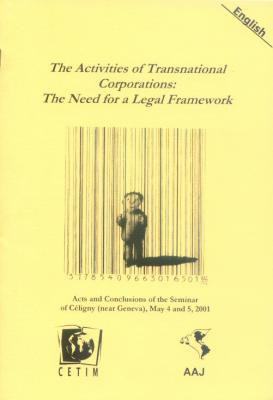
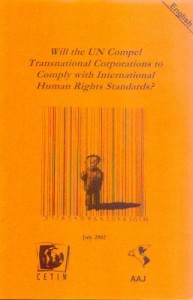
Transnational corporations’ impunity
Melik Özden
2016 – 112 pages
Multinationals with great economic and political power violate human rights, very often, with almost total impunity. These entities escape legal action. This publication demonstrates the necessity and urgency of having a binding international instrument to sanction those multinationals responsible. CETIM’s publication also highlights how important it is to enable the victims to obtain compensation.
Lire la suite
The right to work
Melik Özden
2008 – 64 pages
Work is essential for everybody in the organization of contemporary society. It not only contributes to the formation of the individual, but it is also necessary if one is to be able to support oneself and one’s family, make and keep social contacts and fulfill one’s duties .
Lire la suite
The right to social security
Melik Özden
2012 – 64 pages
Social security is a system of social services intended to counter risks and uncertainties that arise within society. A product of the industrial era and linked to employment, it was initially intended to respond to certain pressing needs, and to institutionalize solidarity within society lest individuals be obliged to depend on charity.
Lire la suite
The right to non-discrimination
Melik Özden
2011 – 64 pages
The right to non-discrimination emanates from the general postulate of the equal dignity of human beings, which has been affirmed by the Charter of the United Nations and the Universal Declaration of Human Rights as well as by all international human rights instruments.
Lire la suite
The right to land
Melik Özden
2014 – 102 pages
The recognition of the right to land, a historic demand by peasant movements throughout the world, is gaining momentum at the international level. This publication takes stock of this major issue of our times. It is the result of major research and inquiry, and the fruit of close collaboration with La Vía Campesina…
Lire la suite
The right to housing
Melik Özden et Christophe Golay
2007 – 64 pages
The right to adequate housing is a universal right, recognized at the international level and in more than one hundred national constitutions throughout the world. It is a right recognized as valid for every individual person …
Lire la suite
The right to health
Melik Özden
2006 – 68 pages
At first glance, it might seem misplaced to speak of health as a right when ever increasing segments of the world’s population are witnessing a steady degradation in the state of their health, to the point where their very existence is threatened …
Lire la suite
The right to food
Melik Özden et Christophe Golay
2005 – 55 pages
The right to food is a human right. It is universal, acknowledged at the national, regional and international level, and applies to every person and group of persons. Currently, however, some 852 million persons throughout the world are seriously –and permanently– …
Lire la suite
The right to education
Melik Özden
2009 – 64 pages
Education is very often seen as a means of attaining other objectives (such as a better job or increased earnings) and that education as a human right in and of itself is often lost sight of .
Lire la suite
The right to development
Melik Özden
2007 – 40 pages
The last decade has been marked by an unprecedented increase in inequalities and a spectacular growth of the gap between “developed” countries and those of the Third World as well as the growth of a gap within countries themselves …
Lire la suite
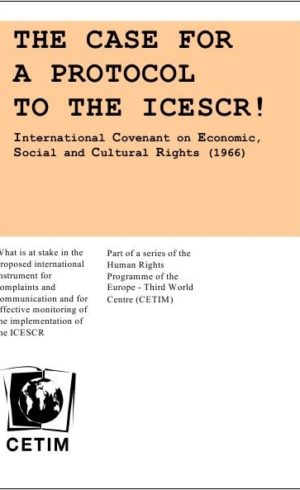
The case for a protocoll to the ICESCR !
Melik Özden et François Ndagijimana
2006 – 40 pages
In paragraph 3 of the common preamble to the two International Conventions of Human Rights – the International Covenant on Civil and Political Rights and the International Covenant on Economic, Social and Cultural Rights – the states parties acknowledge …
Lire la suite
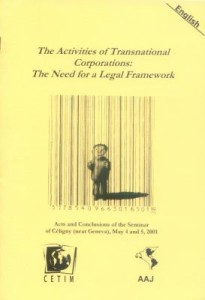
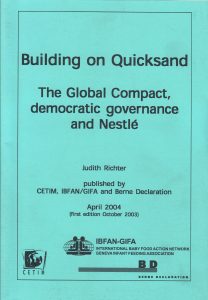
PDF “Building on Quicksand: The Global Compact, democratic governance and Nestlé”
– pages
From the start, various NGOs have been raising questions about the alleged benefits and risks of Global Compact, a high level interaction between the United Nations and the business community. This publication, commissioned by CETIM, Geneva Infant Feeding Association (GIFA-IBFAN) and Déclaration de Berne does not aim to summarize all of these concerns. It rather suggests focusing on two main lines of questioning. These two line emerge from the debates between the Global Compact proponents and its critics: What is the value of the Global Compact in terms of changing corporate practices? More specifically, is it an arrangement that helps shift corporate practices towards the better – or is it rather an arrangement that helps corporations continue to do their business as usual and moreover confers on them additional protection from legally-binding regulation and public pressure? What is the relationship between the Global Compact and global democratic governance? In other words: Does the Global Compact enhance – or undermine – efforts to promote democratic decision-making in a globalising world? Both these questions are addressed at a theoretical level as well as by a case study focusing on the gaps between words and deeds, illustrated with the case of one of the latest prominent participants of the Global Compact: the food and beverage transnational Nestlé. Dr. Judith Richter is author of Holding Corporations Accountable: Corporate Conduct, International Codes and Citizen Action, Zed Books, London and New York, 2001 and ‘We the Peoples’ or ‘We the corporations’, Critical reflections on UN-business partnerships, IBFAN-GIFA, January 2003.
Lire la suite
Internally displaced persons
Melik Özden
2007 – 48 pages
Although forbidden by international humanitarian law and defined by the Statute of Rome (the International Criminal Court) as a “crime against humanity” (art 7.2.d), forced displacements are still largely practiced in our time during armed conflict and in various …
Lire la suite
Showing 1–16 of 32 results
 «Il n‘y a pas un monde développé et un monde sous-développé, mais un seul monde mal développé»