CETIM PRESS RELEASE
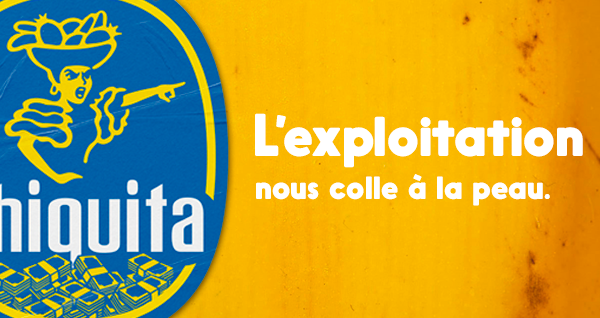
Geneva, April 29, 2026. Public Eye recently published a report denouncing inhumane working conditions on banana plantations operated by subcontractors of the transnational corporation (TNC) Chiquita in Guatemala. This initiative is accompanied by a campaign aimed at putting pressure on the company as well as on the relevant authorities. Chiquita workers report violations of labor rights, including excessive working hours leading to chronic fatigue, insufficient wages, unprotected exposure to toxic pesticides, and limited access to healthcare.
In southern Guatemala, where 85% of the country’s banana jobs are concentrated, working conditions on plantations run by Chiquita’s subcontractors are absolutely hellish: workers endure exhausting workdays to the point that some resort to a narcotic stimulant called “bomba,” consumed up to seven times a day by certain workers. The plantations are sprayed with a toxic pesticide called Mancozeb up to four times a week, without any prior warning. Small aircraft release a yellowish, acidic powder over thousands of hectares of banana plantations at any time of day, directly exposing workers. This product is classified as an endocrine disruptor, toxic to reproduction, and suspected to be carcinogenic.
Thus, Chiquita perpetuates unacceptable working conditions by taking advantage of the relocation of its activities and, above all, by exploiting a young, isolated, and weakly organized workforce. Despite Rainforest Alliance certification, the observed practices fall far short of human rights standards, labor law, and environmental norms. Through subcontracting, the company evades its legal responsibilities while also benefiting from Swiss tax advantages (Chiquita’s headquarters having been located since 2008 in Etoy, in the canton of Vaud, Switzerland).
The Stop Chiquita campaign by Public Eye is fully in line with the information, awareness-raising, and advocacy work that CETIM has carried out for several decades to combat the impunity of transnational corporations. It also echoes the ongoing process at the United Nations aimed at developing a legally binding international framework to regulate the activities of transnational corporations under international human rights law. CETIM and the Global Campaign to Reclaim Peoples’ Sovereignty, Dismantle Corporate Power, and Stop Impunity are actively participating in the current negotiations to ensure that the future legal instrument reflects the proposals of social movements, strengthens corporate accountability, and guarantees access to justice for victims and affected communities.
For this reason, CETIM fully supports and commits to actively contributing to the Stop Chiquita campaign launched by Public Eye. In this context, we also call on people to join the virtual demonstration organized to pressure Chiquita to assume its responsibilities toward its workers.
Switzerland, as the host country of Chiquita, must require the company to comply with the standards of the International Labour Organization, particularly regarding working conditions, trade union freedoms, and fair wages, as well as fundamental human rights. It must also ensure accountability mechanisms in cases of non-compliance.
Furthermore, Switzerland should intervene with the authorities of Guatemala to ensure the effective enforcement of labor standards and human rights within their territory, an essential condition for protecting their population.
Finally, Switzerland must actively support the adoption, at the United Nations level, of a binding treaty on transnational corporations and human rights. Establishing such a legal framework is essential to fill the gaps in international law by establishing prevention mechanisms of violations, independent monitoring, legal accountability, and effective sanctions in cases of non-compliance.
Support the campaign, get mobilized! Workers’ rights are non-negotiable! Stop Chiquita!
Visuals and campaign materials for the Stop Chiquita campaign are available here (only in French).
Contact:
Raffaele Morgantini, CETIM Representative to the United Nations, raffaele@cetim.ch, +41 79 660 65 14
 «Il n‘y a pas un monde développé et un monde sous-développé, mais un seul monde mal développé»