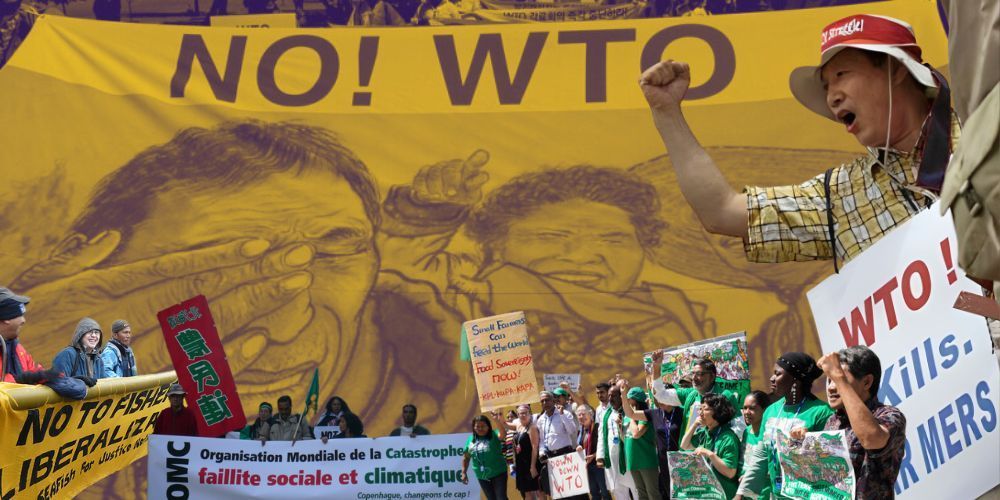
The current architecture of global trade, led by the World Trade Organization (WTO), is at a historic breaking point. The neoliberal model, based on unchecked market liberalization, privatization of public services, and the widespread commodification of all aspects of our societies, has failed to deliver on its promises of development and prosperity. On the contrary, it has established a trade system that serves exclusively transnational capital, from a neocolonial perspective aimed at blocking the development of countries in the Global South, while sacrificing the sovereignty of peoples and the preservation of the biosphere.
The 14th WTO Ministerial Conference, held from March 26 to 29 in Yaoundé (Cameroon), is presented as an attempt to save this institution, which is now in complete deadlock. This impasse is mainly explained by geopolitical tensions between major powers and the United States’ blockage of its dispute settlement body. The paralysis of negotiations thus marks the end of the illusion of a universal neoliberal solution. Faced with failure, OECD powers, led by the United States, are abandoning the multilateral framework in favor of selective liberalism, or even resorting to the law of the strongest.
It should be recalled that agreements negotiated within the WTO, outside any democratic oversight, create a two-tier system that marginalizes the Global South. This reality confirms the DNA of an institution designed not for economic development or fair trade, but to facilitate the expansion and accumulation of capital—at the expense of popular sovereignty, human rights, and the environment. For peoples and many states, the WTO is no longer a space for negotiation, but rather a body that validates an “out-of-touch” order disconnected from social realities.
The agricultural regime imposed by the WTO perfectly illustrates this deadlock. Since 1995, it has systematically criminalized national policies aimed at protecting domestic markets and ensuring fair prices for peasants and small-scale farmers. By treating food as a mere speculative commodity, this framework imposes unfair competition between local peasants and subsidized agribusiness. For food-importing countries and landlocked nations, remaining within this system poses a direct threat to their survival. National sovereignty is seen as an obstacle to capital mobility. In this context, withdrawing from the WTO should not be interpreted as isolationism, but rather as an act of legitimate defense—necessary to redirect investment toward local, national, and regional markets, as well as toward proximity-based systems rooted in agroecology, with the aim of promoting food sovereignty.
This break with the market (dis)order is a prerequisite for restoring the primacy of human rights. Resilience in the face of the multidimensional crisis will not come from further liberalization, but from strong support for local economies. Alongside freeing themselves from the constraints of the WTO, states must also regulate transnational corporations and ensure that global value chains are no longer lawless zones.
Such a rupture is a necessary precondition for refounding the global trade order within the United Nations system—the only legitimate framework for building a bottom-up multilateralism driven by peoples rather than markets. By placing human beings and nature at the top of the hierarchy of norms, we can transform global trade into a vehicle for dignity.
Globalizing the struggle for food sovereignty, through democratic, inclusive governance based on cooperation and international solidarity, is today the only way to globalize hope for a just and sustainable future.
Geneva, 26 March 2026
See also :
Call to mobilize against the WTO and free trade by La Via Campesina:
https://viacampesina.org/en/2026/03/global-call-to-mobilise-against-the-wto-and-free-trade-agreements/
Proposal for a new trade legal framework based on food sovereignty:
https://viacampesina.org/en/2025/09/a-new-global-trade-framework-based-on-food-sovereignty-is-urgent-and-necessary-la-via-campesina/
 «Il n‘y a pas un monde développé et un monde sous-développé, mais un seul monde mal développé»