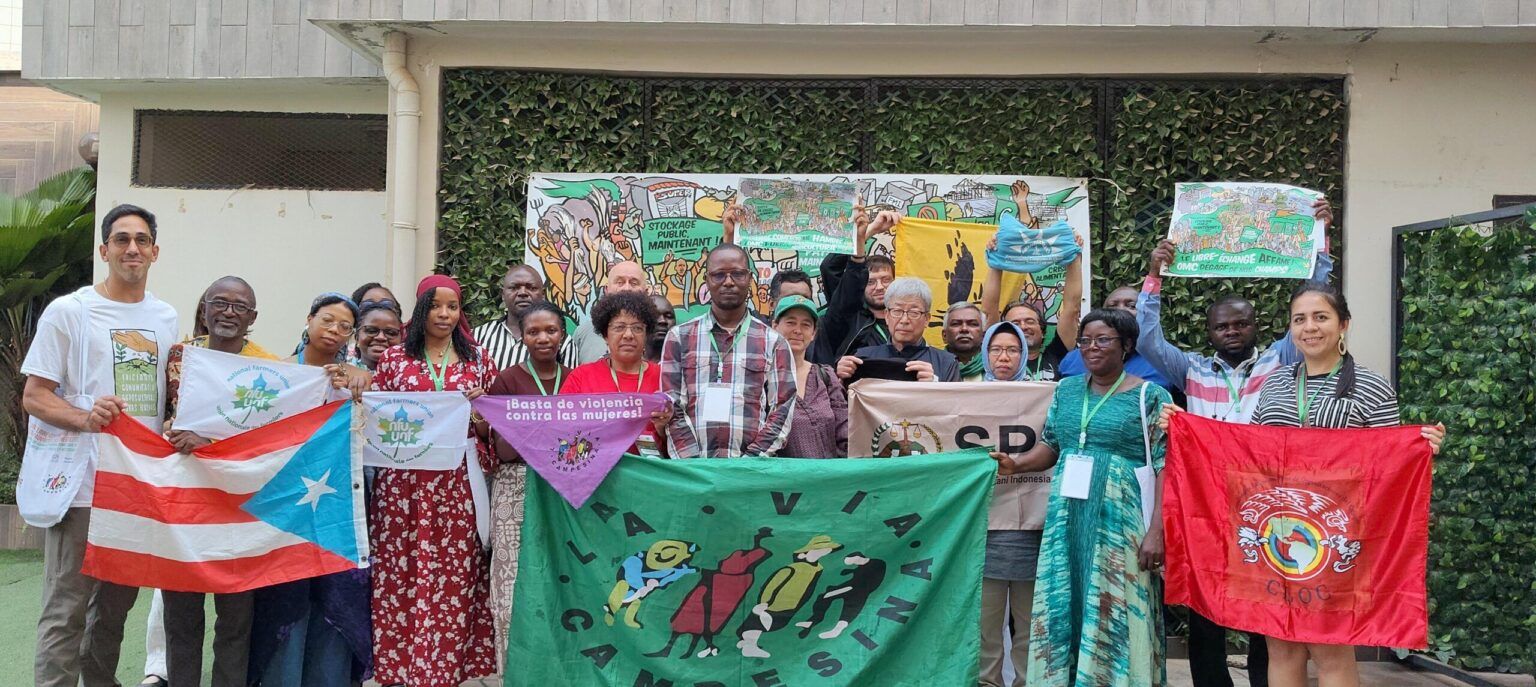
CETIM stood alongside La Via Campesina in Yaoundé, Cameroon, to closely monitor the proceedings of the 14th WTO Ministerial Conference (26–29 March 2026). CETIM and LVC advocate the dismantling of the WTO, as its paradigm is based on a deeply asymmetrical economic and trade architecture that serves the interests of transnational capital to the detriment of local peoples and economies, particularly in the Global South.
The Ministerial Conference concluded without a final declaration or the reform that had been announced. The majority of issues, including agriculture, e-commerce and investment facilitation, were referred back to Geneva due to a lack of consensus. Many participants attribute this failure largely to the strategy of the United States, which made any negotiations conditional on the adoption of a permanent moratorium on tariffs related to e-commerce, causing significant tensions, particularly among countries in the Global South. Disagreements on this issue, as well as on other priorities such as food security and intellectual property rules, stalled the negotiations. This failure thus confirms the analysis that the WTO is now largely paralysed, incapable of producing decisions conducive to fair and equitable trade development, and underscores the need for a fundamental rethinking of the international trading system towards a truly democratic framework that does not marginalise the voices of the peoples and countries of the Global South.
The Yaoundé Declaration, which we reproduce below and which was published by La Via Campesina, highlights the systemic effects of a trade model that subordinates food to the logic of profit, accelerates the marginalisation of small-scale food producers and undermines peoples’ sovereignty over their food systems. Against a backdrop of geopolitical, economic and environmental crises, increased dependence on global markets appears not only as a dead end, but as a factor exacerbating the structural vulnerabilities that oppress people.
In the face of this multidimensional crisis, LVC’s Yaoundé Declaration aims to offer hope by proposing a structured institutional policy alternative. By affirming food sovereignty as a fundamental principle, it calls for a rethinking of international trade based on the primacy of human rights, solidarity among peoples and respect for ecosystems. It thus calls for agriculture to be removed from the WTO and for the current WTO framework to be transcended in order to build a new trading system that serves the self-determination of peoples.
Read the Yaoundé Declaration
Read CETIM’s communiqué prior to the Ministerial Conference: The WTO at a deadlock: Will the Ministerial Conference save it?
 «Il n‘y a pas un monde développé et un monde sous-développé, mais un seul monde mal développé»