By: Raffaele Morgantini, Representative of CETIM (Centre Europe-Tiers Monde) to the United Nations in Geneva
The UN Declaration on the Rights of Peasants and Other People Working in Rural Areas (UNDROP) is increasingly becoming a key normative and political tool for transforming food and agricultural systems, particularly in the Global South. In a context of growing corporate concentration, commodification, and external dependencies, UNDROP provides a framework for strengthening peasants’ rights, food sovereignty, and democratic control over rural development.
Its growing influence results from both grassroots appropriation by peasant and rural organizations and its progressive integration into international and national legal frameworks. UN human rights mechanisms, courts, legislatures and public institutions are increasingly using UNDROP to interpret rights and develop policies concerning land, seeds, food, health, climate, and rural livelihoods. Recent developments in countries such as Honduras, Colombia, Kenya, Ecuador, and Brazil illustrate this shift towards practical implementation.
For the Global South, UNDROP offers a strategic opportunity to strengthen food and agricultural sovereignty, support agroecological pathways, protect biodiversity and traditional practices, and reduce dependence on concentrated global markets. Its effective implementation requires sustained political mobilization, institutional commitment and greater cooperation among States, human rights bodies, legal practitioners and rights holders.
In the current international conjuncture, marked by a systemic and multidimensional crisis, food and agricultural systems have become strategic arenas where dominant economic actors – transnational corporations, the agribusiness sector and financial agents, taking advantage of an asymmetric international legal architecture governing trade and intellectual property – are pursuing strategies aimed at consolidating their influence and control over food chains. These strategies serve the primary objective of securing access to resources and markets within a broader framework of generalised commodification and the maximisation of commercial profits. Within this complex international landscape, however, there are also important grounds for cautious optimism. Notably, a discernible and growing trend points to the progressive consolidation of the United Nations Declaration on the Rights of Peasants and Other People Working in Rural Areas (UNDROP) as a key normative reference at both national and international levels.
While the challenges to its integral and effective implementation remain considerable, it is equally evident that UNDROP is becoming a crucial anchor point for decisions, laws, public policies, debates, and even negotiations across various multilateral mechanisms and spaces. This growing relevance is not incidental; it is the result of a dynamic process of socialisation, promotion and capacity-building that goes beyond formal endorsement, transforming the Declaration into a living tool for advancing the rights it enshrines.
Social appropriation and bottom-up legitimacy
One of the main drivers of this progress is the processof appropriation of UNDROP by its own rights holders. This has strengthened its legitimacy and ensured that the Declaration functions as both a legal and political leverage to claim rights, monitor situations, and engage in meaningful dialogue with public authorities to orient national laws and public policies.
Far from being an abstract instrument, UNDROP is actively used by peasant communities and rural organizations as a normative framework to structure their demands and strategies. This dynamic reinforces its transformative character and its capacity to influence concrete realities and institutional frameworks. Thus, human rights cease to be abstract notions and instead become practical tools for action, grounded in the lived realities, knowledge, and collective forms of organization of communities.
The role of the international human rights protection mechanisms and bodies
The United Nations (UN) Working Group of Experts on UNDROP has played a central role in the Declaration’s promotion, and in clarifying and advancing of its implementation. Through dialogue with States and other actors, the development of interpretative guidance, and the dissemination of its narrative in relevant multilateral spaces, this UN mechanism has significantly contributed to positioning the Declaration within the international human rights system.
Beyond the Working Group of Experts, several UN human rights mechanisms have contributed to strengthening the interpretation and visibility of UNDROP. For example, the Special Rapporteurs on the right to food have played a key role in integrating the Declaration’s principles into broader debates on food systems, emphasizing rights to land, seeds, and food sovereignty[1]. Similarly, the Special Rapporteur on human rights and the environment has highlighted the relevance of UNDROP in the context of climate change and environmental protection, reinforcing the role of peasants, small-scale fishers, pastoralists, nomadic communities and Indigenous Peoples as stewards of natural resources.
Treaty bodies have also advanced this process. In particular, General Comment No. 26[2] of the Committee on Economic, Social and Cultural Rights on land reflects core UNDROP principles, including secure and equitable access to land and the recognition of customary tenure systems. More broadly, concluding observations increasingly address issues central to the Declaration, contributing to its normative consolidation within the international human rights system.
Similarly, the work of the Committee on the Elimination of Discrimination against Women (CEDAW) illustrates a gradual move toward convergence between women’s rights and the rights of rural women. Although General Recommendation No. 34 on rural women (2016) preceded the adoption of UNDROP in 2018, it largely anticipates its concerns by emphasizing land rights, access to natural resources, and food security for rural women. Since the adoption of UNDROP, CEDAW has increasingly drawn on this instrument in its concluding observations addressed to States. In these instances, UNDROP serves as a complementary interpretative framework to strengthen States’ obligations regarding non-discrimination, particularly with respect to rural women’s access to land, livelihoods, and participation in decision-making processes. Thus, UNDROP is gradually becoming integrated into CEDAW’s practice as a reference instrument, contributing to an expanded understanding of the rights of rural women.
From rhetoric to practice: jurisprudential and legislative developments
A growing number of States recognize the value of UNDROP as a practical tool to protect rural populations and fulfill their human rights obligations. This increasing openness is creating favorable conditions for its progressive integration into legal frameworks and public policies.
Case law and jurisprudence
The consolidation of UNDROP is reflected in concrete jurisprudential developments across different countries. Courts are increasingly using the Declaration as a legitimate normative source to interpret domestic legislation and support judicial decisions. These positive institutional practices demonstrate how State apparatus as a whole are aligning its domestic frameworks with international human rights standards to protect the rights of peasants, food, biodiversity, health, etc[3].
The 2018 decision of the Supreme Court of Honduras represents a landmark in this regard. In declaring the so-called “Monsanto Law” unconstitutional, the Court relied explicitly on Article 19 of UNDROP (the right to seeds), affirming that peasant seed systems are protected under international human rights standards. The ruling emphasized that criminalizing the saving and exchange of seeds undermines both cultural practices and food sovereignty, marking one of the first direct judicial applications of the Declaration[4].
This jurisprudential trend has continued and expanded. In 2020, the Inter-American Court of Human Rights began to articulate the complementarity between the rights of Indigenous Peoples and those of peasants in Argentina, signalling an important evolution toward a more inclusive understanding of collective rights in rural contexts. This case[5] marks a milestone in this regard, as the Court explicitly engaged with both the UN Declaration on the Rights of Indigenous Peoples and UNDROP, establishing interpretative bridges between the two frameworks.
In Canada, an important development illustrates another case of how UNDROP is used as a persuasive interpretative tool. In 2020, the Ontario Superior Court of Justice relied on Article 23 of the Declaration (right to health) in a case concerning migrant farm workers exposed to unsafe and overcrowded living conditions during the COVID-19 pandemic. Significantly, the Court recognized UNDROP as part of the broader body of human rights norms that can inform the interpretation of domestic law. This case[6] demonstrates the Declaration’s practical legal relevance even in States that have not supported it and highlights its potential to support strategic litigation aimed at strengthening the protection of rural workers.
In Colombia, the Constitutional Court has broken new ground by linking peasants’ rights with climate change and environmental vulnerability. In a 2025 landmark decision[7] concerning peasants displaced by natural disasters, the Court recognized them as subjects of special constitutional protection and highlighted the State’s obligation to adopt differentiated measures addressing their specific vulnerabilities.
Finally, in Kenya, a landmark decision by the Supreme Court in November 2025 struck down provisions of national seed legislation that effectively criminalised traditional seed practices. The Court found that these measures violated constitutional protections and were incompatible with international standards, including UNDROP (article 19). Importantly, the ruling recognized peasant seed systems not merely as economic activities but as integral to cultural identity, biodiversity, andresilience[8].
Legislative and public policy innovations
In the legislative and public policy sphere, UNDROP is increasingly serving as a reference for the development of innovative legal frameworks.
In Colombia, the constitutional reform of Article 64 adopted in July 2023 represents a historic milestone. While maintaining the State’s obligation to support access to land and rural development, the reform goes further by explicitly recognizing peasants as subjects of rights and of special protection. It affirms their distinct identity, rooted in their relationship to land, food production, and territoriality, and acknowledges them as political subjects. This achievement – resulting from long-standing mobilization by peasant organizations – creates a constitutional mandate to progressively align national laws and policies with provisions reflected in UNDROP[9].
In Ecuador, the National Assembly’s ratification of UNDROP in 2023, following sustained advocacy by peasant and Indigenous movements, has strengthened its role as a guiding framework for legislative processes. This recognition facilitates the mainstreaming of peasants’ rights across public policies and reinforces the Declaration’s legitimacy within the domestic legal order[10].
In Brazil, the National Human Rights Council adopted in 2025 a significant resolution recognizing UNDROP as a key normative standard for the protection of rural populations. The measure calls for its cross-cutting implementation across public policies and encourages State institutions to align their actions with the Declaration, marking an important step toward its institutionalization at the national level[11].
In Cuba, various initiatives adopted since the Declaration reflect a systematic effort to translate its provisions into concrete public policies.[12] Similar processes, oftendriven from the grassroots, are also emerging in countries such as Nepal, Indonesia, Niger, Congo, and Senegal.
A strategic opportunity for the Global South
Taken together, these developments show that the UNDROP is emerging as an increasingly influential benchmark in the governance of rural and agrarian rights.
For countries in the Global South, this development represents a strategic opportunity that goes beyond mere human rights compliance. By integrating the UNDROP into national legal frameworks and public policies, States can strengthen the protection of local food systems and peasantry, thereby asserting greater sovereignty over food production and agricultural value chains. In a context marked by growing concentration of market power and external neocolonial dependencies, promoting the UNDROP as a guiding principle for agricultural and food policies will help reduce vulnerability to global shocks by expanding the scope for manoeuvre of national public policies. In other words, the aim is to mobilise this legal framework to advance the realisation of the Right to Development[13], understood here as the right of peoples to determine their own rural development systems and policies, in a self-determined manner.
At the same time, the UNDROP offers a coherent framework for promoting agroecological developmentpathways that are more equitable and sustainable in rural areas, in particular through its provisions on the right to seeds, environment, water and biodiversity. Supporting small-scale rural practices and traditions is not only a matter of social justice, but also a strategic lever for promoting environmental protection andencouraging adaptive responses to the climate crisis.
In this context, it is important to promote the multilateral fora as frameworks for strategic dialoguebetween States, as well as between independent experts, UN mechanisms and rights holders, in order to foster the exchange of experiences and good practices. In fact, a collective political dynamic is necessary to elevate and strengthen the political status of UNDROP at the national level, so that it can serve as a basis for judicial interpretation, particularly through capacity-building for judges, lawyers, and public officials, as well as the harmonisation of national legislation and public policies with its provisions.
In this sense, we can draw direct links between UNDROP and the broader historical demands for a New International Economic Order (NIEO) and the right to development. Realizing the rights of peasants and other people working in rural areas requires safeguarding the policy space of Global South States so that they can protect and strengthen local food and agricultural systems against the distortive effects of highly subsidized agricultural exports from the Global North. Such policy space encompasses the ability to regulate imports, provide public support to small-scale producers, maintain strategic food reserves, and pursue agrarian and rural development policies that respond to domestic priorities rather than to the imperatives of the transnational agribusiness sector and liberalized global markets.
From this perspective, social movemements, civil society organizatios and committed States can mobilize UNDROP not merely as a legal human rights framework, but also as a lever presupposing an international economic order capable of making those rights effective. Many of the structural constraints identified by NIEO advocates – including unequal terms of trade and asymmetries in decision-making power – continue to shape the conditions under which rural communities seek to exercise their rights. The implementation of UNDROP therefore raises questions that extend beyond domestic legal reform to the dominant architecture of international trade, investment and finance. Without addressing these structural inequalities, the rights enshrined in the Declaration risk remaining largely aspirational.
Conclusion
UNDROP has moved beyond being a declaratory instrument to become an operational tool across multiple levels. Its growing use in courts, legislation, and public policy reflects a process of progressive socialization and institutionalization that is redefining the place of the rights of peasants and other people working in rural areas within contemporary international law.
The implementation of the UNDROP is, by its very nature, a profoundly political and collective process. It is through the interaction between popular participation and institutional advocacy that a favourable balance of power – necessary to bring about tangible changes on the ground – is forged.
In this context, the UNDROP must serve as an essential compass, a collective roadmap, in support of efforts to democratise food and agricultural systems, but only on condition that it is appropriated and actively championed by the communities themselves, in light of their concrete interests.
[1] See the latest reports of the Special Rapporteurs on the right to food (and in particular the reports on food systems, seeds and fisheries, among others):https://www.ohchr.org/en/special-procedures/sr-food/annual-thematic-reports
[2] See: https://www.ohchr.org/en/documents/general-comments-and-recommendations/ec12gc26-general-comment-no-26-2022-land-and
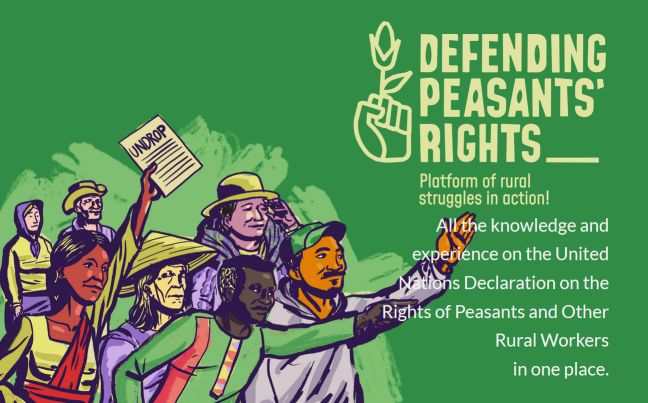
[3] To further explore these developments, platforms such as Defending Peasants’ Rights offer valuable resources on case law, legal tools and practices aimed at supporting the effective implementation of the Declaration. See: https://defendingpeasantsrights.org/en/home/
[4] See: https://defendingpeasantsrights.org/en/honduras-supreme-court-uses-undrop-article-19-on-the-right-to-seeds-to-declare-unconstitutional-the-monsanto-law/
[5] See: https://defendingpeasantsrights.org/en/inter-american-court-of-human-rights-first-case-law-on-the-links-between-the-declarations-on-the-rights-of-peasants-and-indigenous-peoples/
[6] See: https://defendingpeasantsrights.org/en/interview-of-jessie-macinnis/
[7] See: https://defendingpeasantsrights.org/en/colombia-constitutional-court-decision-protects-peasants-displaced-by-natural-disasters/
[8] See: https://defendingpeasantsrights.org/en/landmark-victory-for-kenyan-peasants-and-seed-sovereignty/
[9] See: https://defendingpeasantsrights.org/en/colombia-recognition-of-peasants-as-subjects-of-rights-interview-with-martha-elena-huertas-moya/
[10] See: https://defendingpeasantsrights.org/en/ecuadorian-peasants-win-ratification-of-undrop-by-their-legislative-assembly/
[11] See: https://defendingpeasantsrights.org/en/brazil-national-council-for-human-rights-adopts-key-regulation-to-advance-the-implementation-of-undrop/
[12] See: https://defendingpeasantsrights.org/en/report-on-the-promotion-and-implementation-of-the-undrop-in-cuba/
[13] See: https://defendingpeasantsrights.org/en/the-right-to-development-a-leverage-for-food-sovereignty-and-the-un-declaration-on-the-rights-of-peasants-undrop/
 «Il n‘y a pas un monde développé et un monde sous-développé, mais un seul monde mal développé»