PRESS RELEASE
Geneva, August 14, 2025
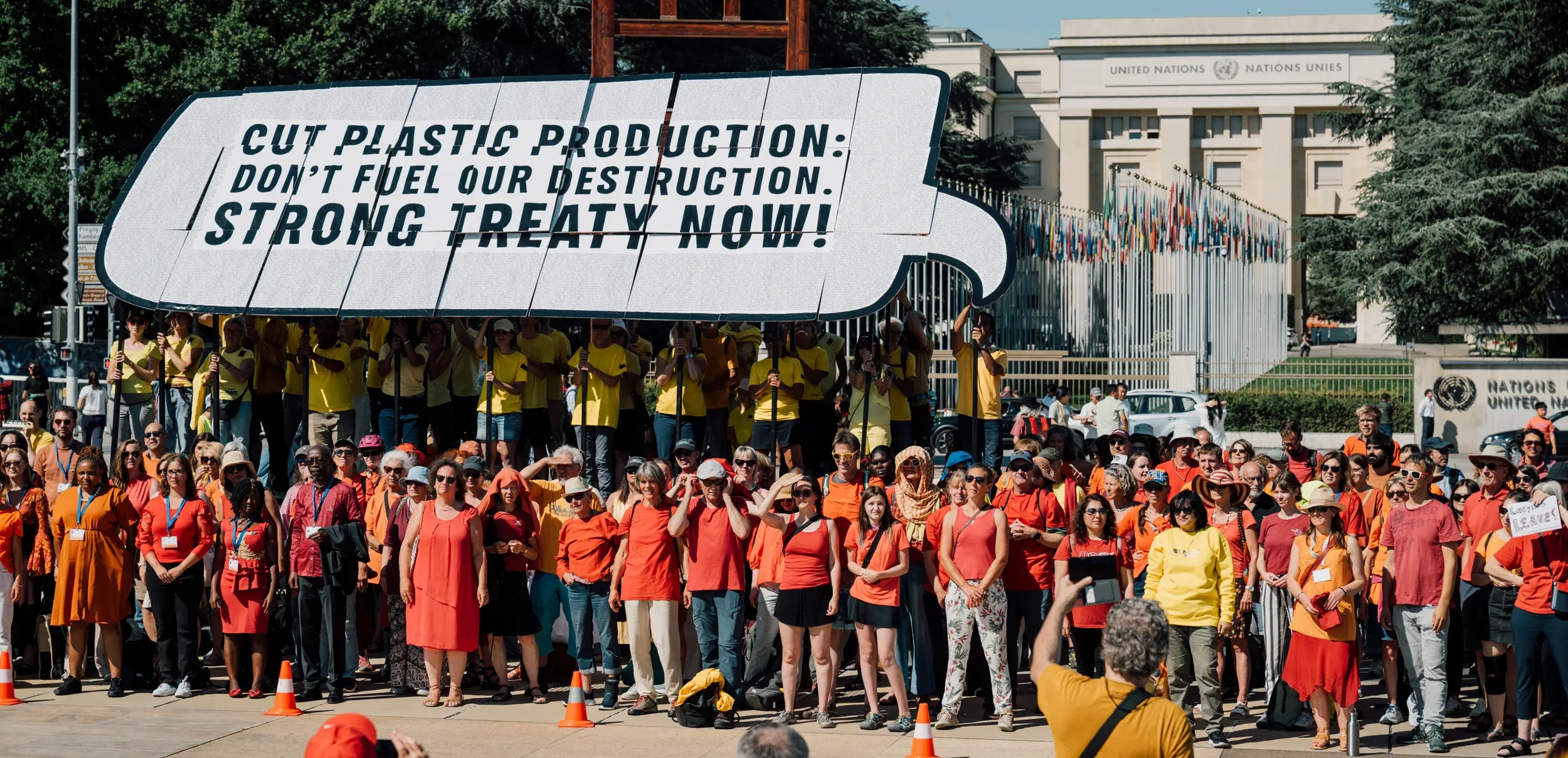
From August 5 to 14, 2025, the fifth round of negotiations on the International Treaty on Plastic Pollution took place at the Palais des Nations in Geneva. As negotiations on this legal instrument draw to a close, CETIM wishes to share its thoughts and express its concerns about this process. Indeed, despite the global urgency of the plastic pollution crisis, everything indicates that the economic and commercial interests of transnational corporations (TNCs) and certain producer states will prevail over the protection of our lives and the environment.
The plastic crisis is of unprecedented scale and is now one of the most pressing environmental challenges. Every year, millions of tons of plastic waste end up in the oceans, soil, and air, threatening biodiversity, human health, and ecological balance. In 2024, global plastic consumption is expected to exceed 500 million tons, generating around 400 million tons of waste. If nothing changes, plastic waste could triple by 2060.
Who is responsible for plastic pollution?
While consumers are often blamed, transnational corporations play a central role in this issue: they dominate global virgin plastic production, design and market single-use products, and often outsource environmental costs to countries with less stringent regulations. Through their globalized supply chains, they perpetuate an economic model that fuels dependence on plastic. The solutions put forward by the dominant powers are limited to recycling initiatives and the introduction of “eco-friendly” packaging, all watered down by the adoption of voluntary standards. However, these measures remain insufficient to reverse the trend, as they are often part of a “greenwashing” strategy, offering the illusion of change while avoiding the profound and structural transformations of the production and consumption model that would be necessary to significantly reduce the global plastic footprint.
The ongoing negotiations, initiated with the hope of moving towards the development of a legally binding instrument covering the entire life cycle of plastics, have unfortunately stalled. A major point of contention remains the inclusion of legally binding accountability mechanisms for reducing plastic production.
TNCs around the table but absent from the treaty
We are witnessing a blatant attempt to strip this treaty of its substance. Large transnational petrochemical corporations and their powerful lobbies are dictating the rules of the diplomatic game, in order to ensure that the future instrument protects the status quo and enshrines their lack of accountability, while increasing their production capacity and reaping colossal profits.
Since talks began in November 2022, seven major TNCs—Dow, ExxonMobil, BASF, Chevron Phillips, Shell, SABIC, and INEOS—have sent 70 lobbyists to the negotiations. At the fifth session (INC-5.2), 234 fossil fuel lobbyists were present, constituting the largest delegation, surpassing even the European Union and its member states. Meanwhile, these seven TNCs produced the equivalent of 6.3 million garbage trucks of plastic and increased their production capacity by 1.4 million tons. Dow alone made a profit of approximately $5.1 billion from plastics while lobbying to weaken the treaty.
This corporate capture aims to divert attention toward false solutions while refusing to address excessive production at the source, which guarantees their profits. Plastic, which is 99% derived from oil and gas, has become a pillar of the growth model of major oil companies and a development model for oil-producing countries.
The latest version of the draft Plastic Treaty proposed by the Presidency, under the influence of TNC lobbies, is so weak that it will neither end plastic pollution nor protect human health and the environment. It represents the lowest possible level of ambition, ignoring the vast majority of proposals from civil society and certain states that have supported concrete measures over the last three years of negotiations. The updated text mitigate all references to reducing plastic production and controls on harmful chemicals, and weakens, among other things, the provisions on just transition. An ambitious treaty must impose a binding and measurable reduction in plastic production worldwide. It is also imperative to include robust mechanisms for holding transnational corporations legally accountable, ensuring that polluters are held legally responsible for the environmental and social damage they cause.
The stakes are enormous. Without strong political will and a balance of power in favor of the public interest, the negotiations will result in a meaningless text. In this context, it is unacceptable that the main polluters are allowed to shape the future treaty that is supposed to put an end to the pollution they generate. States must take action against them and impose a binding treaty that can reverse the status quo, contributing to social and environmental justice.
The fight against impunity for transnational corporations: a long-term struggle
CETIM reiterates its long-standing commitment to fighting impunity for transnational corporations and to ensuring access to justice for victims and communities affected by violations. This fight is being waged not only on the ground, but also at the UN Human Rights Council, where since 2014 an ad hoc intergovernmental working group has been negotiating the drafting of a binding UN treaty on transnational corporations and human rights.
Since then, CETIM, as coordinator of the Global Campaign to Reclaim Peoples Sovereignty, Dismantle the Corporate Power and Stop Impunity, has been actively advocating for this instrument, which aims to fill the legal gaps in holding TNCs accountable for human rights violations. The key principles of this Treaty—such as establishing human rights obligations for transnational corporations, mechanisms for preventing violations and sanctions in the event of non-compliance, and access to remedies for victims—are also essential in the context of the negotiations on the Plastics Treaty.
CETIM will continue to actively support those process and those struggle, alongside social movements and committed organizations, for social and environmental justice, so that the public interest takes precedence over profits.
PDF version of the press release
Notes:
 «Il n‘y a pas un monde développé et un monde sous-développé, mais un seul monde mal développé»